size
capacity



Dr. Franz Rueß, Tobias Gabler, Thorsten Espey
Staatliche Lehr- und Versuchsanstalt für Wein- und Obstbau Weinsberg
agricultural research
MKG Göbel
EPC

Overhead systems with fixed modules
coordinates: 49°15'08.5"N 9°13'37.5"E
The project
Soft fruit
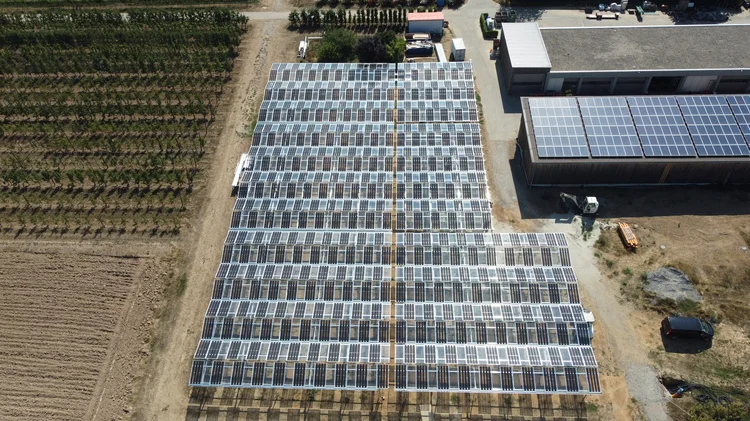
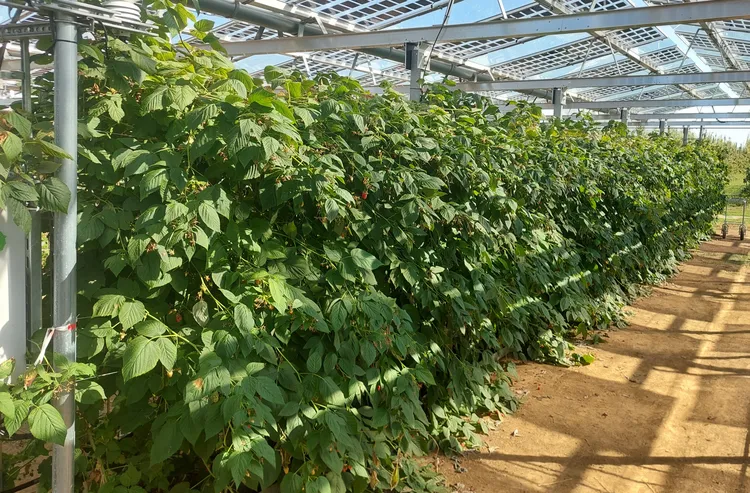
Under the 0.2-hectare agrivoltaic system on the Heuchlingen site, know-how relating to the cultivation of various types of soft fruit (strawberry, raspberry, blueberry, currant, and blackberry) under protective nets is applied to the technical conditions of agrivoltaics. The focus is on adapting the PV technology to the crop requirements.
Increasingly, soft fruit grown under cover is being cultivated without soil – in troughs or pots filled with substrates like peat or coconut coir. The root volume of these container crops is restricted, and the plants have to be watered and also drained, while nutrients must be provided through liquid fertiliser. This project will therefore investigate the impacts of the PV system on the cultivation of soft fruit in (peat-free or peat-reduced) substrate.
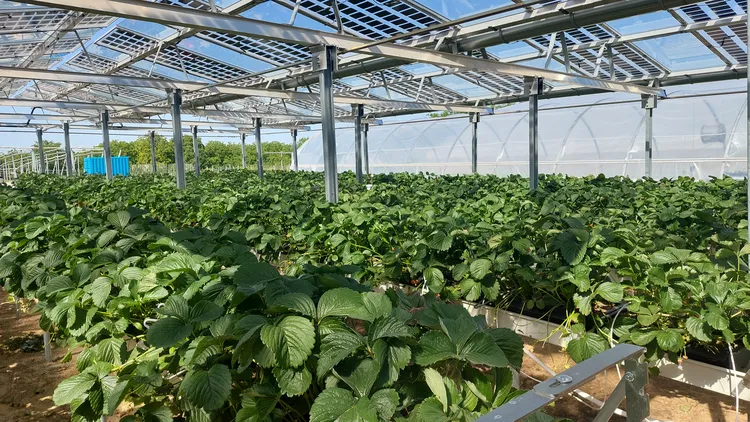
Recycling instead of leaching
The agrivoltaic system in Heuchlingen has a closed-loop design in the form of a roof that collects rainwater. Because of the water hardness, the collected rainwater is better for irrigation purposes than well water. The collected rainwater is enriched with a nutrient solution for optimal plant growth. Since container crops are always given more water than they actually need, the excess irrigation water (drain water) is collected, cleaned and returned to the irrigation cycle. The energy needed to run the pumps, Dosatron, water softening and control system will be supplied by the agri-PV plant, which has a peak installed output of 113 kWp.
Stone fruit
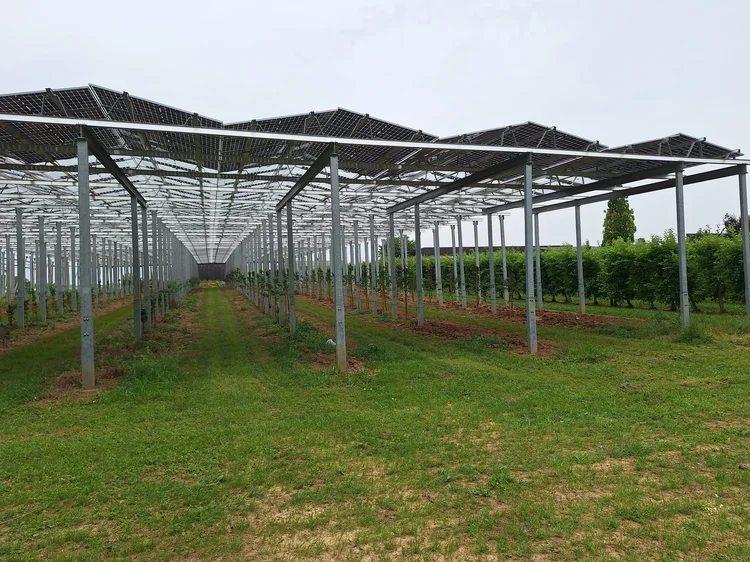
The second agrivoltaic facility in Heuchlingen was built in 2024 to demonstrate whether agrivoltaics is a promising solution for growing sweet cherries. The 0.2-hectare system has a total length of 80 metres, with the headlands measuring six metres each. A reference plot of the same size was set up with a conventional net. The system is equipped with a permanent net to protect against spotted wing drosophila. It is also possible to net the PV plant temporarily to prevent birds eating the fruit. After harvest, the net can be removed again, as is usual with conventional fruit-growing systems.
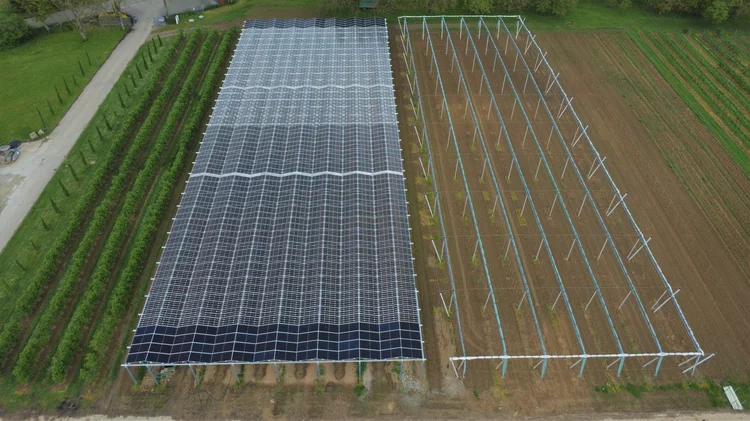
When planning the agrivoltaic system, particular attention was paid to the rain-proof roof over the trees to prevent yield losses caused by precipitation events. An opening in the roof ridge ensures that heat does not build up under the PV modules. Furthermore, the wire trellis for training the trees can be attached to the posts supporting the PV modules. The wire support structure for the irrigation lines can also be attached to the posts.
The trees were planted in March 2024. They comprise 12 market cultivars that account for a major share of sweet cherry production volumes, now and in the medium term. The questions concerning suitability for cultivation under agrivoltaic conditions are particularly important for this group of varieties. The trees were grafted in 2022 and planted in 2024 as feathered ‘knip’ trees.
The project is studying how the shade from the PV modules affects fruit quality, the microclimate, disease and pest infestation. It is also investigating the advantages and disadvantages of agrivoltaics systems compared with conventional netted systems, in terms of crop production and labour efficiency. In addition, a number of different tree training systems are being tested to see whether they are suitable in the context of cultivation under agrivoltaic conditions.
Technical details
The agrivoltaic system has three zones with different types of PV modules and different transparency levels:
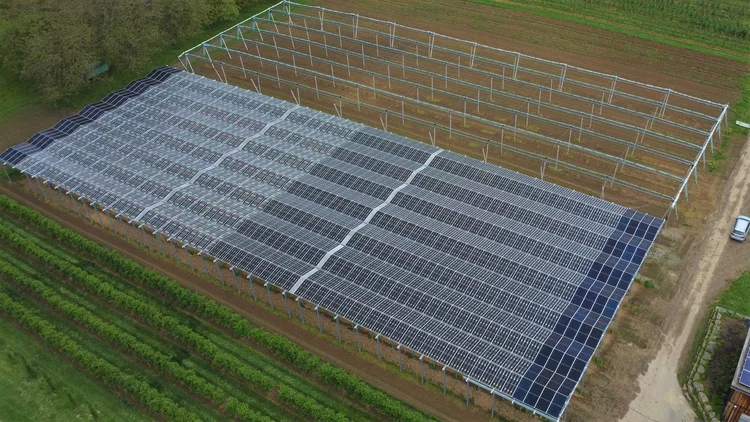
- Zone 1 – maximum transparency: bifacial, semi-transparent double-glass modules, approx. 77% transparency, 115 Wp (approx. 55 kWp)
- Zone 2 - medium transparency: bifacial, semi-transparent double-glass modules, approx. 49% transparency, 250 Wp (approx. 119 kWp)
- Zone 3 – minimum transparency: headlands with bifacial, semi-transparent, double-glass modules, approx. 10% transparency, 455 Wp (approx. 51 kWp)
The entire PV system has a peak output of 225 kWp. In order to optimise the efficiency of the facility, almost fully shading bifacial PV modules were installed in the outer four metres of the headland. These PV modules produce more electricity. Semi-transparent PV modules were installed in the two metres of headland immediately adjacent to the crowns. This ensures that sufficient light reaches the trees, which has a positive influence on photosynthesis.
for the location