size
capacity

Prof. Dr. Andreas Schweiger
Universität Hohenheim
agricultural research
Martin Hibsch
AgriPV-Solutions GmbH
EPC

Overhead system with fixed modules
coordinates: 48°44'36.5"N 8°55'18.0"E
The project
Overview
An overhead agrivoltaic system that combines arable farming with photovoltaics was erected in summer 2024 at the Ihinger Hof experiment station. The 0.4 ha research site will be used to research questions of practical relevance. The plan is to establish a three-crop rotation (e.g. winter wheat, potatoes and legumes) under the PV system and on a reference plot. This will allow all the crops to be observed and evaluated simultaneously over at least three years. The focus of the research is on the effects of shade on plant development, soil characteristics, the incidence of pathogens and the microclimate.
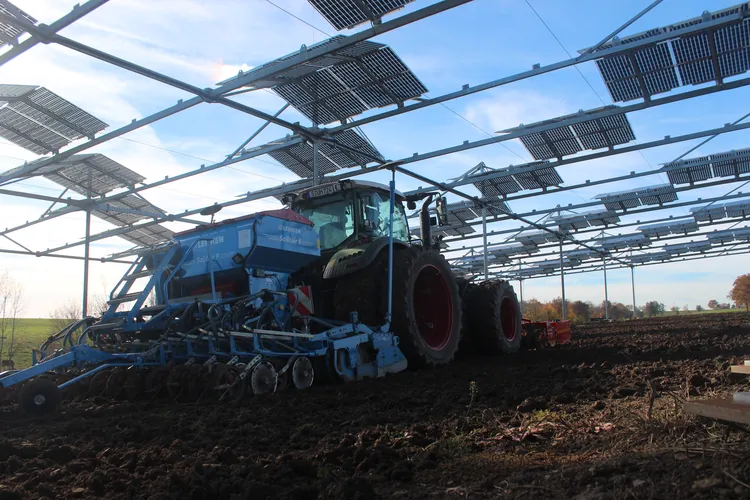
The PV system was specifically designed by the University of Hohenheim and Fraunhofer ISE to meet future research needs. The aim is to obtain a wealth of new findings to inform future advice to farmers. The interdisciplinary setup at the University of Hohenheim (involving plant ecology, physics and meteorology, biogeophysics, phytopathology, soil biology, biobased resources in the bioeconomy, and economic-ecological policy modelling) ensures that the potential of agrivoltaics for arable farming can be developed holistically.
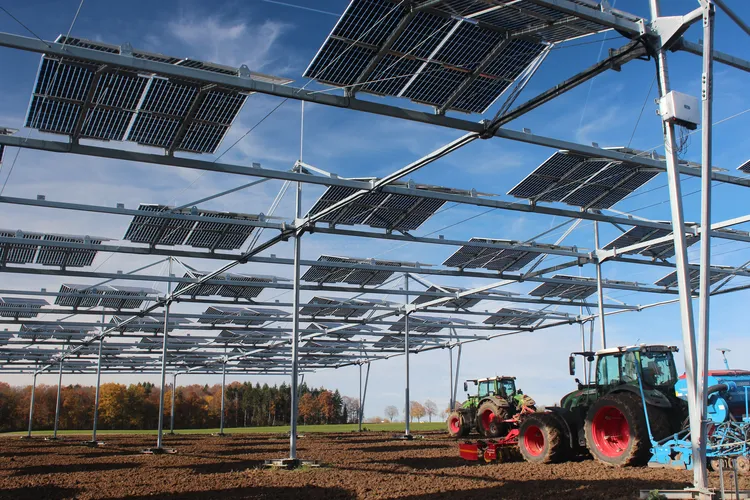
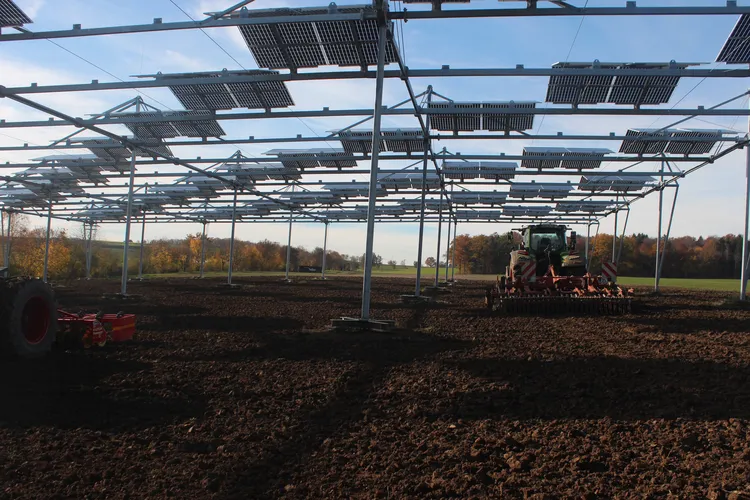
The PV system has a particularly innovative design. The module support frames are arranged in a staircase that rises from east to west and can be positioned flexibly within the array. This makes it possible to try out a wide range of different shade variations. Each frame holds eight 455 W transverse, bifacial PV modules. Together, they shade 30% of the ground.
for the location